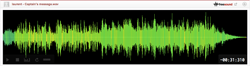
This sound uses S: harmonica1.wav by swapnil_gt | License: Creative Commons 0
This sound (like an organ) transforms the specified just above. It was done for the 8A Peer Assessment of the ASPMA Coursera course. Following is the explanation I gave of how I got the uploaded sound using the HPS model from the sms-tools software:
The analysis parameters are window='blackman', M=1201, N=2048, t=-80, minSineDur=0.1, nH=40, minf0=450, maxf0=850, f0et=5, harmDevSlope=0.001, stocf=0.1.
The original sound consists of the notes C5, D5, E5, G5. I scale frequencies in order to get enharmonic differents between the notes so I would have C5 and B5 sharp, first, and E5 and F5 flat later. So:
Frequency scaling factors: [0, 1, 1.5, 1, 1.59, 0.901, 2.235, 0.901, 2.26, 1,2.94, 1, 3.03, 0.83239, 5.027, 0.83239]
I scale time factors in order to get that each note last approximately one second, and compressing intermediate spaces between notes.So:
Time scaling factors: [0, 0, 1.5, 1., 1.59, 1.0001, 2.235, 2., 2.26, 2.001, 2.94, 3., 3.03, 3.0001,5.027, 4.]
After checking different combinations with factors 1, 0.9, 0.8, 1.1 and others, I decided strecth all frequencies by 0.9 since I get the best result, at least for my taste. So:
Frequency stretching factors: [0,0.9, 1, 0.9]
Because of the same reason, I prefer Timbre preservation = 1.
Type
Wave (.wav)
Duration
0:03.996
File size
344.3 KB
Sample rate
44100.0 Hz
Bit depth
16 bit
Channels
Mono
Comments