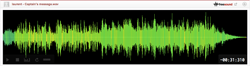
This is my own field recording of Sperm Whales, echolocating, in Southern Bay, north of Princeton, Newfoundland. The clicks' frequency can suggest a whale's size and the rate, the distance between the whale and an object (e.g., prey).
Background scientific information regarding Sperm whale echolocation: a Sperm whale head contains the spermaceti organ, a cavity filled with almost 2,000 L of wax-like liquid, and the junk compartment, comprising a series of wafer-like bodies believed to act as acoustic lenses.
Echolocation signals are produced with consistent inter-click intervals (of approximately 0.4 s) while coda clicks are arranged in stereotypical sequences called “codas” lasting less than 2 s. Codas are characterized by the different number of constituent clicks and the intervals between them (called inter-click intervals or ICIs). Codas are typically produced in multi-party exchanges that can last from about 10 s to over half an hour. Each click, in turn, presents itself as a sequence of equally spaced pulses, with inter-pulse interval (IPI) of an order of 3–4 ms in an adult female, which is the result of the sound reflecting within the spermaceti organ.
Source of background information: https://www.ncbi.nlm.nih.gov/pmc/articles/PMC1691849/
My equipment: Sound Devices mixpre-6 II and an Aquarian Audio hydrophone.
Type
Mp3 (.mp3)
Duration
1:30.593
File size
3.5 MB
Sample rate
44100.0 Hz
Bitrate
320 kbps
Channels
Stereo
Comments

1 year, 3 months ago
The splashing was from the waves against the hull of the RHIB. Assuming the hydrophone cable was too short and therefore too close to the boat.

1 year, 3 months ago
It sounds like splashing water between clicks. Was this just part of the sonar signal and reflections that sounded like splashing water? Or are there actually splashing water sounds mixed in?