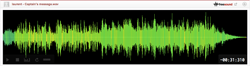
Instrument: Orchestral Chimes/Tubular Bells, Chromatic- C3-F4
Note: E, Octave 2
Volume: Pianissimo (pp)
RR Var: 1
Mic Setup: 6 SM-57's: 4 in Decca Tree (side-stereo pair-side), 2 close
Type
Wave (.wav)
Duration
0:11.576
File size
2.9 MB
Sample rate
44100.0 Hz
Bit depth
24 bit
Channels
Stereo
Comments

10 years, 11 months ago
Daniel, I took some time to study your claim and have come to the conclusion that this is legitimately an E. The reason you may mistake it as a G# or some other note is because tubular bells do not follow the standard harmonic series, and therefore, the fundamental frequency of the instrument is not actually the "root" frequency of the note. Your ear knows that G# is a harmonic of E, and it hears the high E strongly, so it constructs the non-sounding low E beneath the G# artificially.
(you can find more information on this phenomenon in this Vi Hart video: https://www.youtube.com/watch?v=i_0DXxNeaQ0#t=673 (11:13))
Another approach to this question: If you compare this to the sample "C4", you will notice that this note sounds a third higher. As the "C4" sample is clearly an octave above the "C3" sample and a fourth above the "G3" sample, we can assert through intervals what note this is. Go ahead and compare these relationships between the samples and a piano.
So yes, while the fundamental and harmonics may seem strange on a spectrogram, the note sounds as an E.
10 years, 11 months ago
I'm not sure that this is Note: E...