Log in to Freesound

Problems logging in?
Don't have an account? Join now

Problems logging in?

Enter your email or username below and we'll send you a link to help you login into your account.

Back to log in

Almost there!

We've sent a verification link by email

Didn't receive the email? Check your Spam folder, it may have been caught by a filter. If you still don't see it, you can resend the verification email.

Default title

  • Sounds
  • Tags
  • Forum
  • Map
    • Sounds
    • Packs
    • Forum
    • Map
    • Tags
    • Random sound
    • Charts
    • Donate
    • Help

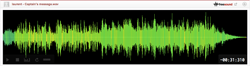
atlas5e-1mix.wav

Overall rating (7 ratings)
P
pixelmasseuse

May 6th, 2010

Follow
Music > Solo instrument

sonification of the ATLAS experiment collision display from the CERN Large Hadron Collider. Here the sounds are produced from samples that I recorded from a Balinese gamelan, specifically, the two lowest gangsa instruments - the jegogan and the calung (aka jublag) from a 5-tone pelog gamelan expanded into 9 tones. the resulting 9-tone scale is close to a 9 tone equal temperament, but not quite...

Sound illegal or offensive? Flag it!
9et
atlas
balinese
calung
collider
data
experiment
gamelan
gangsa
hadron
jegogan
jublag
large
lhc
metallophone
physics
proton
sonification

Type

Wave (.wav)

Duration

1:46.626

File size

17.9 MB

Sample rate

44100.0 Hz

Bit depth

16 bit

Channels

Stereo

Comments
Please log in to comment
P
pixelmasseuse

7 years, 11 months ago

If you want gamelan samples, try Soniccouture. Their pro level gamelan sample package is like $240, but there is a basic version available through Native Instruments for 70 bucks. It uses the Kontakt free player, so you don't need anything additional... just feed it MIDI.

V
Viiuan

7 years, 11 months ago

Would I be able to recieve the samples you used? I would be using them simply for hobbyist musical purposes

P
pixelmasseuse

12 years, 10 months ago

thanks. I did the interpolation graphically using a jpeg of the particle trails from the CERN website. I used max/msp to trace circular paths around the image, then converted the resulting RGB values into note triggers for two sample-based instruments, which were also implemented in max/msp.

A
AntonWebern

12 years, 10 months ago

This is awesome. I wish I had the programming skills to interpolate data like this. I would like to use data from X-Ray Pulsar star systems.

  1. 375 downloads
  2. 4 comments
Attribution 3.0
You are free to share (to copy, distribute and transmit) and to remix (to adapt and modify) as long as you credit the author of the sound. Get attribution text...
Login to download
Share url:
920 x 245
Embed example, large size
481 x 86
Embed example, medium size
375 x 30
Embed example, small size
About Freesound Terms of use Privacy Cookies Developers Help Donations Blog Freesound Labs Get your t-shirt!
© 2026 Universitat Pompeu Fabra
