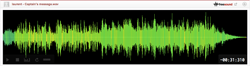
Seismic waves of the giant Sumatra-Andaman earthquake (magnitude 9.1, 26th Dec 2004), that generated the devastating tsunami around the Indian Ocean.
The data is sped up 5,000 times to audible range: 2 seconds audio is about 3 hours in reality.
You can first hear the body wave train (P- and S-waves), followed by body waves as a low to high pitch chirp. The earthquake was so strong that the surface waves circled the earth several times: you can hear them coming from the other side of the earth rapidly after their first arrival, and then a few times again after that.
Large aftershocks also send large surface wave trains and after the first arrivals, it is hard to distinguish them from the pulses of the mainshock.
The seismic waves are recorded far away from the epicenter of the earthquake to capture the separation of the body and surface waves (in the middle of the Algerian Sahara, station TAM, Geoscope network, horizontal component).
---
TAM seismic station: http://geoscope.ipgp.fr/scripts/stations/fiche.php?sta=TAM&id=
Resources on the Sumatra earthquake / seismic waves circling the earth: https://www.iris.edu/hq/inclass/poster/sumatra__andaman_island_earthquake
Sonification method:
A seismometer (seismic station) records ground velocity in time. This data can be turned into sound by speeding it up, as ground motion is usually in infrasonic frequencies. Most seismic data can be freely (although not easily) downloaded from https://service.iris.edu/fdsnws/dataselect/1/.
Type
Wave (.wav)
Duration
0:25.920
File size
2.2 MB
Sample rate
44100.0 Hz
Bit depth
16 bit
Channels
Mono
Comments