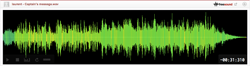
Nature-Symphony 81 (Close companions exploring new mountains) — An elaboration of Nature-Symphony 22 (Solar rays — The Sun's 'Poem of Ecstasy'). (Please read its notes to get the full picture.) I described that work as "A massively profound and inspiring piece for those who can open to it!". This work also answers that description, but more so. Because its textures are denser much of the time, with more complexity of detail and tonal centres and harmonic shifts, no doubt it would be dismissed / shunned by even more people!
The work's primary drama and driving force is not in obvious physical dramatics, nor rhythm, but in constant immensely meaningful harmonic shifts, usually against any or all of three main sustained tones (the upper one actually two, a whole tone apart), one an octave plus a fourth below that, and another, quieter one sometimes emerging, a fourth below even that. A half-diminished seventh chord is generally lurking around, based on the lowest sustained tone, sometimes coming more out in the open, but much of the time it's more or less camouflaged by so many other intensely meaningful harmonic shifts and unorthodox 'cadences' that resolve one tension only to land the listener in a different one. The half-diminished seventh is a chord that really makes its mark in my Symphony 4 (https://www.philipgoddard-music.co.uk/sym4.htm ).
The original field recording for all layers is https://freesound.org/people/Philip_Goddard/sounds/686909/
For detailed information about the Davis Blanchard chimes, please see https://www.philipgoddard.com/shop/store-2-windchimes.htm, just scrolling down a little.
Chime used (for both layers):
(solo metal chime): Davis Blanchard The Blues (tuned to a gentle Blues scale)
I made the original recording for this work on 16 February 2017, on the rough slope just below Hunting Gate, which latter marks the highest point of the Hunter's Path, high up on the north side of the Teign Gorge, Drewsteignton, Devon, UK.
I classified this work for this site as 'Music: multiple instruments' although it was only one chime used, because to classify it as 'solo instrument' would give a hopelessly wrong impression of the nature of the work.
Advisory
To get the best out of this, listen with high-grade headphones.
For most potentially amenable people a second listening would be needed before they could at least properly attune to it.
Note that many speaker systems — particularly lower-grade ones — have 'peaky' over-bright treble, and through any of those, parts of this work would likely sound abrasive and horrible to listen to!

Making the recording following the original one for this work. The 'The Blues' chime looked identical to the Pluto chime in this photo, and of course for this recording there were no bamboo chimes.
Techie stuff:
The recorder was a Sony PCM-D100, with two nested Windcut furry windshields, on a Zipshot Mini tripod.
Post-recording processing was to apply EQ in Audacity to correct for the muffling effect of the windshields.
To create Nature-Symphony 22 I made two copies of the first (most active and loud) half of the original recording, to be used as layers in Audacity, and processed them as follows:
Layer 1: reduced speed to achieve pitch of an octave below original
Layer 2: reduced speed to achieve an octave plus a fourth below original
To create this Nature-Symphony I used those two layers unchanged, but made a copy of that pair, then further slowed those two layers to give a pitch reduction of a tritone. I further lowered their pitch by a major third, so that they were a minor seventh below the corresponding original layers. I actually tried various pitch reductions at that stage, most of them sounding impressive but more chaotic. The pitch reduction chosen, then, was for that which gave the best sense of musical cohesion and meaningful relationship between upper and lower pairs of layers.
Final pitch reductions: Layer 1: octave, Layer 2: octave + 4th, Layer 3: octave + minor 7th, Layer 4: 2octaves + minor 3rd.
Acoustic for all layers: back of cathedral.
For all layers, immediately following the speed reduction I also used my standard wind-cut preset in TDR-Nova GE to greatly minimize microphone wind noise, and used it also to tame the sometimes over-loud sustained tone in layer 3. I did try likewise taming the prominent higher (twin) tone in the top layer, but in that case I found that the filtering notch was taking too much out of the overall sound, so I accepted that sometimes the particular tone would be a bit more prominent than I'd intended — albeit not critically so.
I retained the alignment of the original two layers so that they started playing simultaneously, with the slower speed of Layer 2 getting increasingly out of step with Layer 1. Likewise for the new pair of layers, but as they were slower, they'd get increasingly out of step with the upper two layers as well as out of step with each other.
Additionally, I decided to bodily move the upper pair so that they start at nearly nine minutes in. I wasn't going to, but I was determined that one particular moment in the upper pair was going to be properly heard, so I ensured that it coincided with a quiet patch in the lower pair. That, then, left rather longer than I wanted before the upper pair got heard. I therefore copied a short clip near the end of the upper pair, and pasted it at a suitable position in the middle of the initial silence there.
I allowed the end of Layer 1 to define the end of the work, deleting all that lay beyond.
Please remember to give this recording a rating — Thank you! 
This recording can be used free of charge, provided that it's not part of a materially profit-making project, and it is properly and clearly attributed. The attribution must give my name (Philip Goddard) and link to https://freesound.org/people/Philip_Goddard/sounds/840551/
Type
Flac (.flac)
Duration
53:06.989
File size
190.2 MB
Sample rate
44100.0 Hz
Bit depth
16 bit
Channels
Stereo
Comments