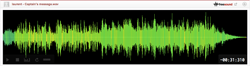
From among the general sea sound on the rugged rocky extensions of the cliff base, we periodically hear a decidedly eerie pulsing blowhole, which isn't whoomphing or roaring, but relatively quietly grunting instead (indeed, as though grunting to itself!), and sounds all the world as though there's some mysterious machine working away down there under the cliff base.
The grunts and splashdowns are not a continuous feature, but come in groups, depending on size and direction of individual waves, and indeed on the state of the tide, being a mid-tide phenomenon.
On 23 August 2019, once again I walked the very rocky and in places scrambly route on the coast path from St Ives to Zennor, Penwith, Cornwall, UK. I was rather hoping for some seals to be making their rather eerie moans, for I still had to get a really good recording of that, but this wasn't my lucky day for that.
I set up a recorder just beyond Economy Cove, just before Mussel Point, at least to capture a pleasant mild thundering sound from the modest swell breaking on the rocks, though that was a bit underwhelming, but also thought to place the second recorder I was carrying on the clifftop above a point in Economy Cove where the pulsing blowhole does its stuff — the only catch being that the blowhole is very tide-sensitive, and there were just the occasional more commonplace deep boomy thuds.
I found a position quite close to the best position to record the blowhole, where there was at least some very nice detailed sound to sea action on the cliff-base rocks, and rather dubiously started recording there. After I'd had my packed lunch I thought it was probably time to move on, but it was then that I noticed that the blowhole was starting to perform, so I moved the recorder to right above the cleft out of which the jets were issuing — and this here is what I captured.
Advisory
The blowhole grunts are relatively quiet and contain a lot of very low frequencies, and need high-grade playback systems for them to be heard well. The best option is to use high-grade headphones with extended frequency range.

Making this recording. Compare with the rock formations in photo below, and you can see approximately where the blowhole jets would be in this view.
The outlying rock island is well-known as 'Seal Island' (marked as 'The Carracks' on Ordnance Survey maps), and gets very busy with boats taking tourists from St Ives to gawk at the seals or lack of them on the rocks there.

The pulsing blowhole while making this recording (from a little bit right of the recorder). Not the usual loud roar or whoomph of a blowhole, but a rather eerie very deep grunt each time.
Techie stuff:
The recorder was a Sony PCM-D100, with three nested custom Windcut furry windshields, placed on a standard-size Zipshot tripod. Although using three furries improved wind protection, I learnt not to use so many in general. In particular this was an issue for any quiet soundscapes, because of the considerably raised level of self-noise caused by the strength of the EQ necessary for that many furries.
Post-recording processing was to apply EQ in Audacity to correct for the muffling effect of the windshields, and to compensate for the D100's weakness in the really low frequencies.
Please remember to give this recording a rating — Thank you! 
This recording can be used free of charge, provided that it's not part of a materially profit-making project, and it is properly and clearly attributed. The attribution must give my name (Philip Goddard) and link to https://freesound.org/people/Philip_Goddard/sounds/679918/
Type
Flac (.flac)
Duration
72:23.140
File size
419.1 MB
Sample rate
44100.0 Hz
Bit depth
16 bit
Channels
Stereo
Comments