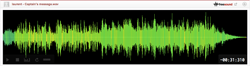
This is the second of four recordings from what I regard as a 'pinnacle' session, capturing my most dramatic seascapes yet. It's the first 1h12' of the lower recorder's second recording (total 2h42').
Large waves crashing closely around us as though about to wash us away or swallow us up. This is loud and dramatic, with the breaking larger waves sounding quite apocalyptic! A few times early in the recording the blowhole very close-by can be heard amongst the pandemonium of the crashing waves. The relatively peaceful interludes between the groups of crashing larger waves are still seething and writhing, with an almost constant fluctuating deep rumbling with the odd thuds included. Sometimes you may notice very distant sound of breaking waves on the right. That is the surf rolling into Perran Bay at Perranporth (Cornwall, UK). That's more noticeable in the recordings from the upper position.
To hear this to best effect you need high-grade headphones, and to have the volume setting about 9dB above a sensible normal level for a realistic rendition of symphonic orchestral music.
I seemed to have already got the Shag Rock headland pretty-well covered by a succession of recordings there, but what I still lacked was good recordings of really apocalyptic-sounding larger waves there. The trouble was that waves beyond a certain size would make it risky to downright suicidal to go down there at all — and then the wind would also be too strong for me to record or indeed to hitch-hike out in the first place. And waves just comfortably larger than I'd already recorded still almost always came with too-windy conditions for useful recording with what equipment I had.
Then on 16 December 2019 at last the surf forecast was for an 8ft swell, though reducing to 6ft during the afternoon, with reasonably light SW wind, which could possibly enable me to find sufficient shelter to record on that headland. Unusually I hitch-hiked straight to Perranporth, with no hike to precede any recording session. I had two Sony PCM-D100 recorders with me, and placed one in the same position by the 'breathing' cleft that I used for my 2015 'Eerie vigil with Shag Rock blowhole' recording. I had it pointing roughly west, obliquely along / facing the waves.
The energy of this soundscape was such that even during apparently quiescent periods, in the vicinity of this recorder I could hear and feel a pretty-well constant very deep fluctuating subterranean rumbling with frequent little thuds.
In this stretch of coastline there's generally no shore, the sea coming right up to the cliff base even at low spring tide. Normally, even with a quite big swell, the waves wouldn't break at all during high tide, but would do so just a little way out at low tide, especially if it were a spring tide, so that then it's the noisy run-out that hits the cliffs. On this occasion only the odd largest wave was breaking initially, which is why wave breaking episodes were only occasional during the first recording from both recorders. The strength of waves varies in cycles, so we'd usually get a group of waves breaking and creating a sonic mayhem before we have another peaceful spell (with writhing and rumbling menaces).
I placed the other recorder on the cliff-edge pointing in about the same direction, but a little bit higher up, so it had a more open sea panorama and got less of the blowhole sounds. I'd intended this recording to run for about three hours for both recorders, but by the time half-an-hour had elapsed I was getting increasing nagging concerns about that lower recorder, lest it might have been caught by one or more blowhole ejections.
— And it was just as well I did, because I found some little puddles of seawater on the recorder. After a hurried wipe-dry job with handkerchief I hastily moved the recorder back by probably about 10 metres to a very slightly higher spot, which I had to do anyway because the wind had started blowing on the recorder in its original position. That then was the spot for the much longer (2h42') second recording, giving a rather different perspective on the increasingly frequent crashing of breaking waves.
Meanwhile I also had to move the other recorder just a little to bring it into better shelter from the wind.
This, then, as I've intimated, is part of the second recording from the lower recorder.

An earlier photo, pointing out the approximate position of the recorder (its exact position is hidden from here)

The second recording in progress. The upper recorder to left, and the lower one (this recording) lower down, to right (pointed out by the arrow). Both are pointing in the same direction.
Techie stuff:
The recorder was a Sony PCM-D100, with two nested Windcut furry windshields (custom design), and it was placed on a Hama lightweight tripod.
Initial post-recording processing was to apply an EQ curve to compensate for muffling from the furry windshields, while adding a shaped very low bass boost to correct for a weakness in that range in D100 recordings.
Please remember to give this recording a rating! 
This recording can be used free of charge, provided that it's not part of a materially profit-making project, and it is properly and clearly attributed. The attribution must give my name (Philip Goddard) and link to https://freesound.org/people/Philip_Goddard/sounds/664163/
Type
Flac (.flac)
Duration
72:11.359
File size
327.5 MB
Sample rate
44100.0 Hz
Bit depth
16 bit
Channels
Stereo
Comments